Buying
BOSS GT-1000 vs GX-100 vs ME-90: Signal Chain, Controls and Amp Modeling
These processors share BOSS’s modern AIRD direction, but they answer very different questions about how much of the signal path you want to design yourself.
Research guide · Updated September 6, 2026Three ways to find your sound
ME-90: familiar knobs and fast adjustments. GX-100: touchscreen editing and movable blocks. GT-1000: deeper routing for a more elaborate rig.
Compare the chains, loops and controls →Compare the candidates
Pick your way to play
Open the processor that matches your workflow, or read on for the full comparison.
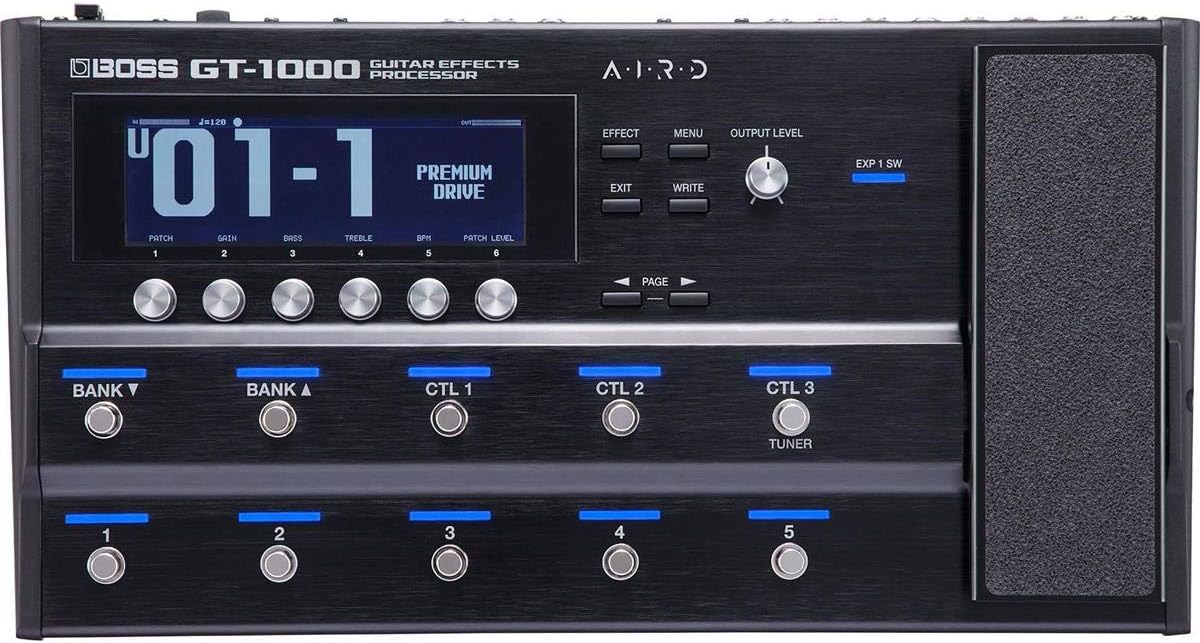
BOSS GT-1000
BOSS’s flagship AIRD floor processor with 32-bit/96 kHz processing, deep routing, dual send/return loops and extensive performance control.
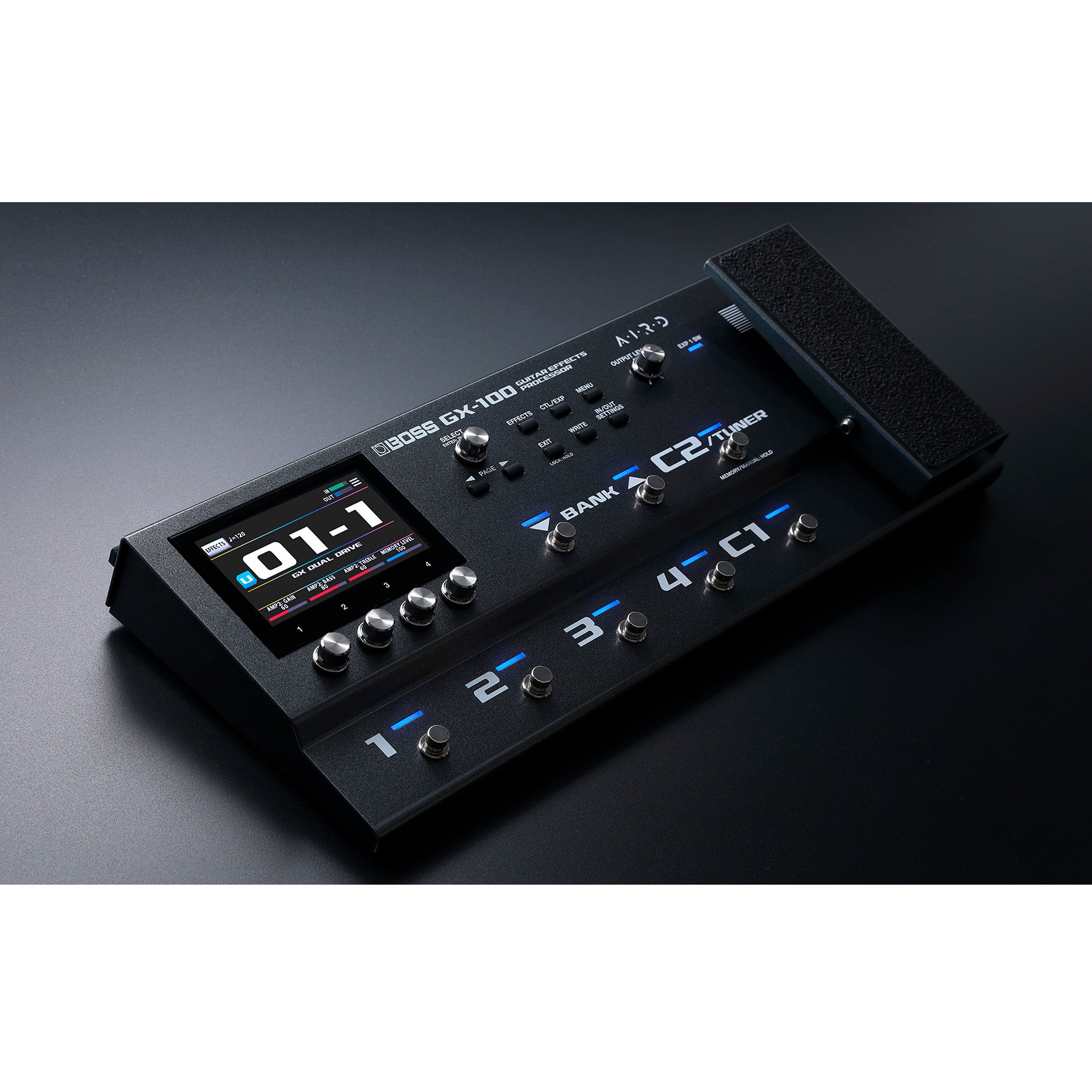
BOSS GX-100
AIRD amp modeling, freely arranged chains and a color touchscreen make complex routing visible and practical onstage.
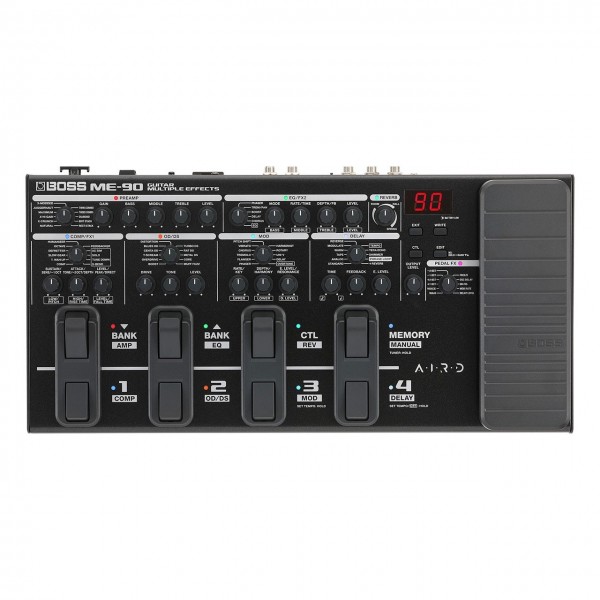
BOSS ME-90
A knob-driven multi-effects floorboard with 11 AIRD amp models, 60 effects and an operating style close to individual pedals.
| Decision | GT-1000 | GX-100 | ME-90 |
|---|---|---|---|
| Signal-chain design | Deepest routing: up to 24 effects, three dividers and multiple series or parallel paths. | Visual routing: up to 15 effects and functions, with one divider/mixer and drag-and-drop series or parallel paths. | Mostly fixed pedalboard-style order, prioritizing immediate operation over modular routing. |
| External effects loop | Two send/return blocks that can be placed within the designed chain. | One send/return block that can be moved within the chain. | One loop with a system choice to place it before or after the preamp. |
| Physical editing | Non-touch display, six parameter knobs, ten footswitches and an expression pedal. | Color touchscreen, four parameter knobs, eight footswitches and an expression pedal. | Dedicated effect-section knobs, eight footswitches and an expression pedal. |
| Amp and speaker system | Two AIRD preamps, separately selectable amp and speaker combinations, and 16 user speaker-IR locations. | Two amp blocks, fixed amp/speaker combinations, and support for imported speaker IRs. | Eleven onboard AIRD amp models and three user speaker IRs, with fewer surrounding routing choices. |
| Best fit | Complex multi-path, dual-amp or deeply integrated hybrid rigs. | Players who want flexible routing with the clearest visual editing workflow. | Players who want labeled knobs and familiar stompbox-style operation. |
The decision in one minute
Choose the GT-1000 when the architecture of the rig is the project: multiple amps, parallel paths, external loops, MIDI and detailed output control. Choose the GX-100 when you want much of that creative freedom in a more visible touchscreen workflow. Choose the ME-90 when direct knobs and conventional pedalboard operation matter more than moving every block. The ME-90 is not simply a cheaper version of the other two; it is built around a different operating idea.
Signal-chain modification is the dividing line
The GT-1000 lets you move effects, amp blocks, dividers and loop blocks throughout a patch. BOSS supports multiple series and parallel routings, up to three dividers, two AIRD preamps and two send/return loops. That makes wet/dry paths, dual-amp blends and complex four-cable-method layouts practical rather than theoretical. The GX-100 also supports freely arranged series and parallel blocks, but within a 15-block architecture with one divider/mixer, one send/return and two amp blocks. Its drag-and-drop screen makes the route much easier to understand while you build it.
Why send/return placement matters
A send/return loop is not just a connection for an extra pedal; its position determines whether that pedal hears the raw guitar, a modeled preamp or the already-processed signal. On the GT-1000 and GX-100, the loop can be placed where the rest of the signal design requires it. That is important for the four-cable method, because the amplifier’s preamp becomes a deliberate block inside the processor path. It also lets you place a favorite overdrive before a modeled amp, or a delay and reverb after an amplifier’s preamp. The GX-100 has one loop and the GT-1000 has two, which is a meaningful difference for players integrating more than one external device.
The ME-90 chooses a fixed, familiar order
The ME-90 publishes a mostly fixed path: Pedal FX, compressor/FX1, overdrive/distortion, preamp, send/return, noise suppressor, EQ/FX2, foot volume, modulation, delay and reverb. The processor automatically optimizes that chain for the selected effect. You can move the send/return before or after the preamp, which is useful, but you cannot treat the entire unit like a blank modular canvas. That fixed order is a limitation for parallel-routing experiments, but it is also why the ME-90 feels immediate: its sections behave like a row of familiar pedals.
Physical controls: three different answers
The GT-1000 uses six contextual parameter knobs, a display, ten footswitches and an integrated expression pedal. It offers the most assignment depth, but editing is the most processor-like: select a block, navigate its pages and learn the control assignments. The GX-100 combines a color touchscreen with four parameter knobs, a select knob, eight footswitches and an expression pedal. You can see the chain, touch a block and drag it into position, then use physical knobs for the selected parameters. The ME-90 puts a dedicated knob section in front of you for each major effect family, along with eight footswitches and an expression pedal. It is the fastest to adjust by feel, while deeper alternate-effect choices and organization live in BOSS Tone Studio.
AIRD amp modeling: related family, different system depth
All three units use BOSS’s modern AIRD approach rather than the older COSM branding. The GT-1000 is the flagship implementation, with 32-bit/96 kHz processing, two simultaneous AIRD preamps, separate amp and speaker choices, extensive output-select options and room for 16 user speaker IRs. The GX-100 uses AIRD with BOSS’s Tube Logic approach, supports two amp blocks and imported speaker IRs, and is designed to make the same kind of direct, FRFR and amplifier-return work more approachable. The ME-90 explicitly uses amp models ported from the GT-1000: eleven onboard amp types, dedicated cab sounds and three user IR slots. The practical difference is therefore not that the ME-90 lacks serious amp modeling; it gives you fewer amp-routing and speaker-combination decisions around those models.
Which one fits the way you work?
The GT-1000 is the strongest choice for a player who wants to design a complete virtual rig, split it into parallel paths or integrate several external devices. The GX-100 is the sweet spot for players who want substantial chain modification without turning every edit into menu work. The ME-90 is the strongest choice for a conventional pedalboard workflow, quick rehearsal adjustments and players who would rather turn a labeled knob than inspect a routing screen.
Bottom line
For maximum signal-chain freedom, the order is GT-1000, GX-100, then ME-90. For immediate physical control, the order reverses: ME-90, GX-100, then GT-1000. If send/return placement, parallel routing and two-amp architecture are central to your sound, start with the GT-1000 or GX-100. If your ideal board is a familiar sequence of compressor, drive, amp, modulation, delay and reverb with a knob for each job, the ME-90 may be the better instrument even though it offers less architectural freedom.
Sources and verification
Specifications were checked against current BOSS and Roland documentation. Workflow conclusions are editorial comparisons of those published capabilities.
Shop by purpose
Explore buying gear
Compare routing, connections and control requirements at the retailer before choosing.
BOSS GT-1000
Open this when dual-amp paths, two movable loops and the deepest routing are non-negotiable.
Shop boss gt-1000 02BOSS GX-100
Open this when touchscreen chain editing and one movable loop fit a simpler live rig.
Shop boss gx-100 03BOSS ME-90
Open this when labeled knobs and stompbox-style operation matter more than modular routing.
Shop boss me-90